For more than a century, cities have been organized around roads, parking lots, and personal vehicles. But the next evolution of mobility might not take place on the ground at all. A wave of research programs and policy pilots has begun testing AI-controlled passenger and cargo drones, suggesting a future where traffic jams are no longer an inevitability but an outdated symptom of street-level transit.
Why Urban Mobility Is Shifting to the Air
Congestion in major metropolitan areas has reached historic highs. The Texas A&M Transportation Institute reports that drivers in the United States lost more than 3.5 billion hours to traffic delays in 2024. Traditional congestion solutions — widening roads, adding lanes, and redesigning intersections — have reached their limit.
Aviation-based mobility offers something cars cannot: a third dimension of movement. Instead of competing for surface space, drones create entirely new transport corridors above city rooftops.
This transition mirrors the broader urban shift toward multimodal transport discussed in EOSel’s earlier coverage of The 5-Minute City and the Future of Eco-Commuting, which explored the move away from car-dependent design.
The Technology Behind Autonomous Drone Travel
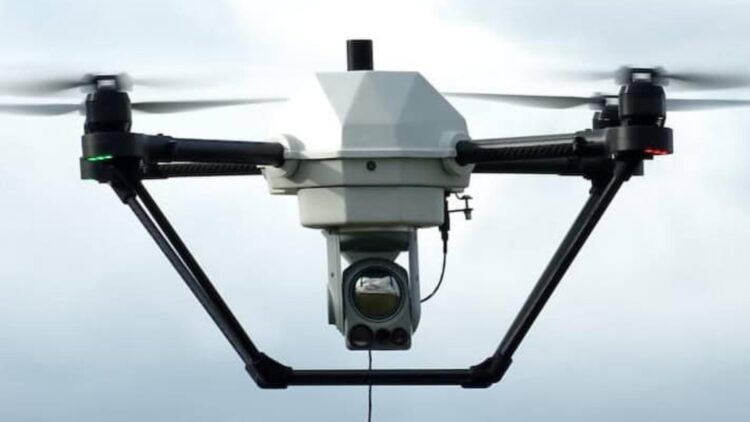
Unlike traditional piloted aircraft, AI urban drones navigate using a fully automated sensing and decision system. Onboard processors integrate:
• LiDAR and radar data
• Computer vision from high-resolution cameras
• Real-time GPS and terrain mapping
• Predictive routing algorithms for collision avoidance
A central air-traffic network manages the global picture, allocating altitude lanes and spacing across hundreds or thousands of drones simultaneously. Where traditional aircraft rely on human oversight, the system works more like a self-organizing digital ecosystem.
Several prototypes are in development, including the EHang EH216, Volocopter VoloCity, and Wisk autonomous air taxi, each designed as quiet, electric rotorcraft suitable for dense cities.
Why AI Control Matters
Large-scale drone mobility is only possible if every vehicle behaves predictably. Human pilots cannot safely operate hundreds of craft per square mile, but AI can.
Predictive flight models make thousands of adjustments per second based on wind, temperature, battery load, building proximity, and traffic patterns. The system becomes safer as more drones operate, not less — a core distinction from road traffic.
The most compelling early results come from Dubai’s Autonomous Air Mobility Test Program, which has logged successful multi-vehicle routes without pilot input and plans commercial rollout later this decade. Researchers say the data could become the blueprint for global deployment.
Where Cities Are Testing Drone Transit First
The transition won’t happen everywhere at once. Governments are focusing first on logistics and emergency use cases, including medical deliveries, rapid supplies, and high-priority transit during disasters.
Urban air-mobility corridors are being mapped in:
• Los Angeles
• Singapore
• Dubai
• Seoul
• Shenzhen
Shenzhen’s city planning bureau reports that AI routing has already reduced delivery times for medical supplies by 67 percent in pilot districts. These efficiencies echo the logic of climate-friendly smart logistics technologies covered previously in EOSel’s AI for Energy Efficiency report.
The Social Question: Who Gets to Fly First?
Prototype pricing shows that early drone taxis will not be cheap. Urban futurists warn of a potential inequality gap if air transit becomes a premium escape route while everyone else remains stuck in traffic.
But history suggests otherwise. Air travel, ride-hailing, and electric vehicles all began as luxury products before expanding into mainstream use once scaling began. Policy analysts argue that public integration, not private exclusivity, will determine whether drone mobility becomes a transformation or a novelty.
Environmental Tradeoffs and Carbon Impact
Electrified drone mobility produces fewer emissions than road transport, but the energy cost of vertical takeoff remains high. Manufacturers are now experimenting with:
• Horizontal assisted takeoff
• Rotational wing designs
• Magnetic acceleration (similar in principle to the system discussed in the EOSel article China’s Maglev Rocket: A Leap Toward Ultra-Fast Spaceflight)
The intersection of drone aviation and clean propulsion may determine whether aerial mobility becomes not just efficient, but climate-neutral.
What the Next Decade Could Look Like
A likely early consumer milestone is drone airports, known as vertiports, positioned on top of parking garages, malls, and transit hubs. From there, electric drones may eventually integrate into everyday travel:
• Downtown to airport in eight minutes
• Home delivery without vans
• School and medical transport without buses
• Traffic-rescue routing during emergencies
Traffic may not disappear entirely, but the upper atmosphere of cities could become a new transportation layer — relieving pressure on road networks the same way fiber-optic networks relieved pressure on copper-wire telephones.
Conclusion
Goodbye traffic jams is not a marketing slogan; it’s a plausible projection. AI-controlled drones are not just rewriting aviation — they are redefining how cities could function when transportation is no longer limited by asphalt and intersections. As infrastructure planners shift from streets to skyways, the question is no longer whether aerial mobility will arrive, but how soon cities will choose to embrace it.