The Country That Turned Sunshine Into Strategy
No other nation has harnessed sunlight quite like Australia.
A decade ago, solar energy was a fringe technology; today, it’s a national economic engine.
With more than 35% of Australian homes generating their own electricity, and solar farms stretching across Queensland, South Australia, and the Northern Territory, the country has quietly built one of the most advanced solar ecosystems in the world.
According to the Clean Energy Council’s 2025 report, Australia now ranks first globally in per-capita solar generation — and third in total installed capacity per household.
It’s not just a transition. It’s a transformation.
The Rooftop Revolution That Started It All
Solar adoption in Australia began with rooftops.
When the first feed-in tariffs were introduced in the early 2010s, installation rates skyrocketed. By 2020, panels had become as common as air conditioners.
Fast-forward to 2025:
- Over 3.6 million households now operate solar PV systems
- Rooftop solar provides one-third of the nation’s daytime electricity
- Average system size has grown from 3 kW to 9 kW in less than a decade
As Australia Just Overtook Coal: How the Sun and Wind Rewired a Nation showed, this distributed generation model has become the foundation of Australia’s clean grid success.
Today, even suburban homes are exporting power back to the national network — and earning credits that help flatten their energy bills.
The Rise of the Outback Solar Giants
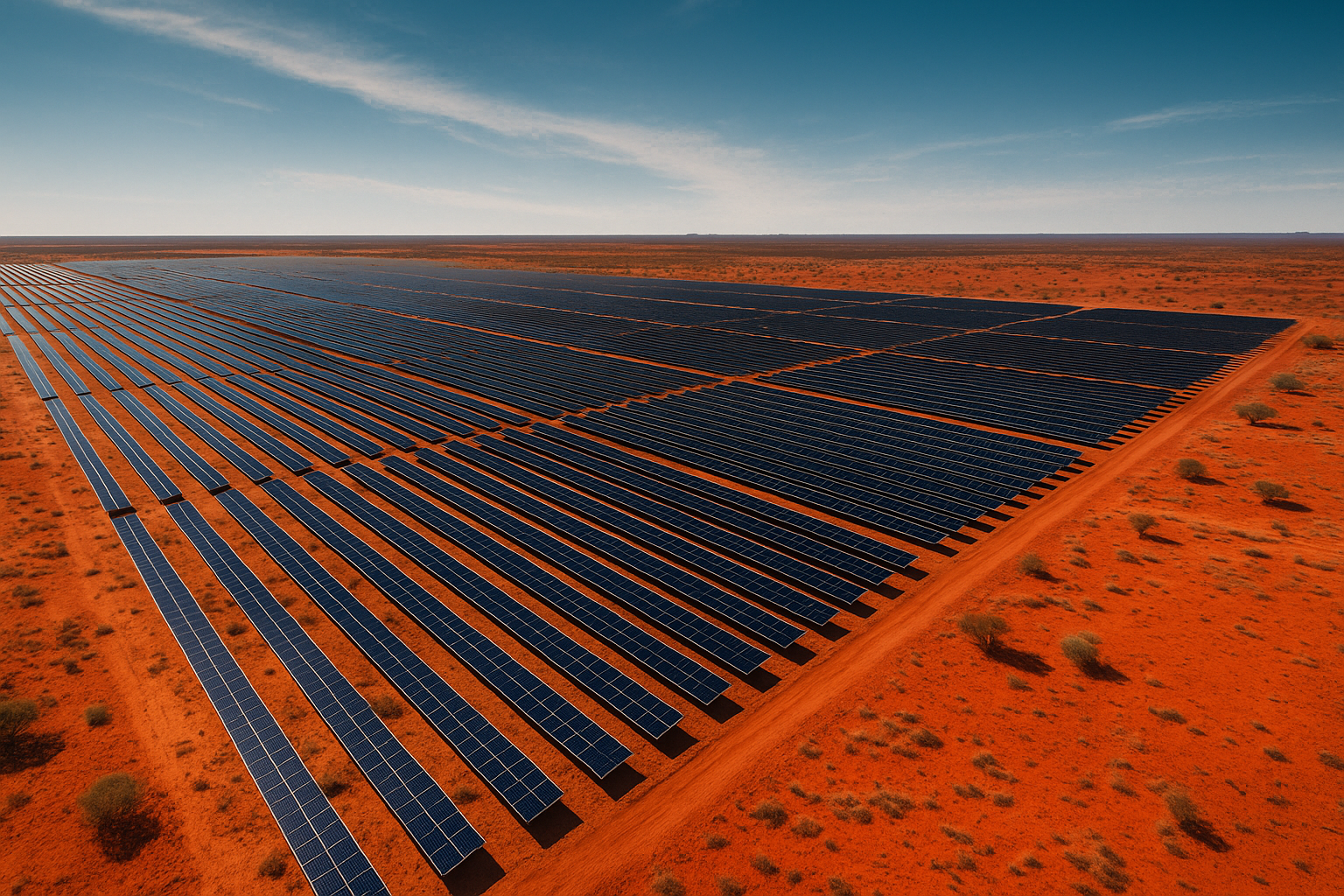
While rooftops built the base, solar farms built the scale.
Projects like the Sun Cable initiative in the Northern Territory — a proposed 20 GW solar array with an undersea cable to Singapore — symbolize Australia’s ambition to become a global renewable exporter.
Further south, Limondale Solar Farm in New South Wales and Bungala Solar Farm in South Australia together generate enough electricity to power more than half a million homes.
| Project | Capacity (MW) | Location | Key Feature |
|---|---|---|---|
| Sun Cable (Australia–Asia PowerLink) | 20,000 | NT | Solar export via undersea cable |
| Limondale Solar Farm | 349 | NSW | One of the largest in Australia |
| Bungala Solar Farm | 220 | SA | Early large-scale storage integration |
| Western Downs Green Power Hub | 400 | QLD | Supplies CleanCo QLD |
| Darlington Point | 275 | NSW | Grid-connected to TransGrid |
These mega-projects represent the industrial backbone of Australia’s solar future — a network of clean power hubs linking cities, mines, and coastal ports.
Policy, People, and Persistence
Australia’s success wasn’t inevitable. It came from a persistent alignment of innovation and policy.
The federal Renewable Energy Target (RET) laid the foundation, while state-level schemes kept momentum alive when national politics stalled.
Feed-in tariffs, low-interest green loans, and ARENA grants supported both households and companies.
Meanwhile, Australians’ pragmatic attitude — “if it saves money, it works” — ensured adoption didn’t depend on ideology.
“Solar is now just another household appliance,” says Katrina Brookes, policy analyst at the Grattan Institute. “It’s part of how Australians live.”
How Batteries Locked in the Gains
Solar’s only weakness is timing: most energy is generated when it’s least needed.
But as Inside Australia’s Battery Boom: The Quiet Revolution Powering Every Home explored, storage has solved that challenge.
Home batteries, grid storage, and community microgrids have transformed solar from an intermittent source into a 24-hour power system.
The Hornsdale Power Reserve and Waratah Super Battery act as balancing agents, soaking up excess daytime power and discharging it after dark.
This synergy — sunlight plus storage — is what truly made Australia a solar superpower.
Beyond Energy: A New Export Identity
Australia has long been known as a resources nation, exporting coal, iron ore, and gas.
Now, a new export industry is emerging: sunlight, reimagined as electrons and hydrogen.
Projects under development aim to:
- Export renewable electricity to Asia via high-voltage undersea cables
- Produce green hydrogen for Japan and Korea
- Manufacture solar cells and batteries domestically
The government’s Hydrogen Headstart program and Rewiring the Nation plan are key enablers, positioning Australia as a potential clean energy exporter by 2030.
The Department of Climate Change, Energy, the Environment and Water (DCCEEW) now calls solar and hydrogen the “twin pillars of Australia’s future economy.”
The Environmental Dividend
Beyond the grid, solar is reshaping Australia’s carbon footprint.
According to AEMO’s Integrated System Plan 2024, emissions from the power sector have already dropped by 40% since 2005.
If the current pace continues, Australia could reach its net-zero electricity goal by 2032, well ahead of schedule.
Solar’s contribution extends beyond energy — it has driven:
- Cleaner manufacturing
- Electrified transportation
- Reduced dependence on volatile fossil markets
It’s an environmental dividend with an economic upside.
FAQ
Is Australia really the world leader in solar?
Yes. Australia leads the world in per-capita solar generation and rooftop adoption rates, according to the Clean Energy Council and IEA reports.
Why is solar so popular in Australia?
High sunlight availability, falling technology costs, and strong household economics have made solar the most accessible renewable source.
How do solar exports work?
Projects like Sun Cable aim to transmit electricity across borders using high-voltage DC cables, turning solar power into a tradeable resource.
What’s next for solar in Australia?
Expansion into storage, hydrogen, and manufacturing — creating a fully integrated clean energy economy by 2030.