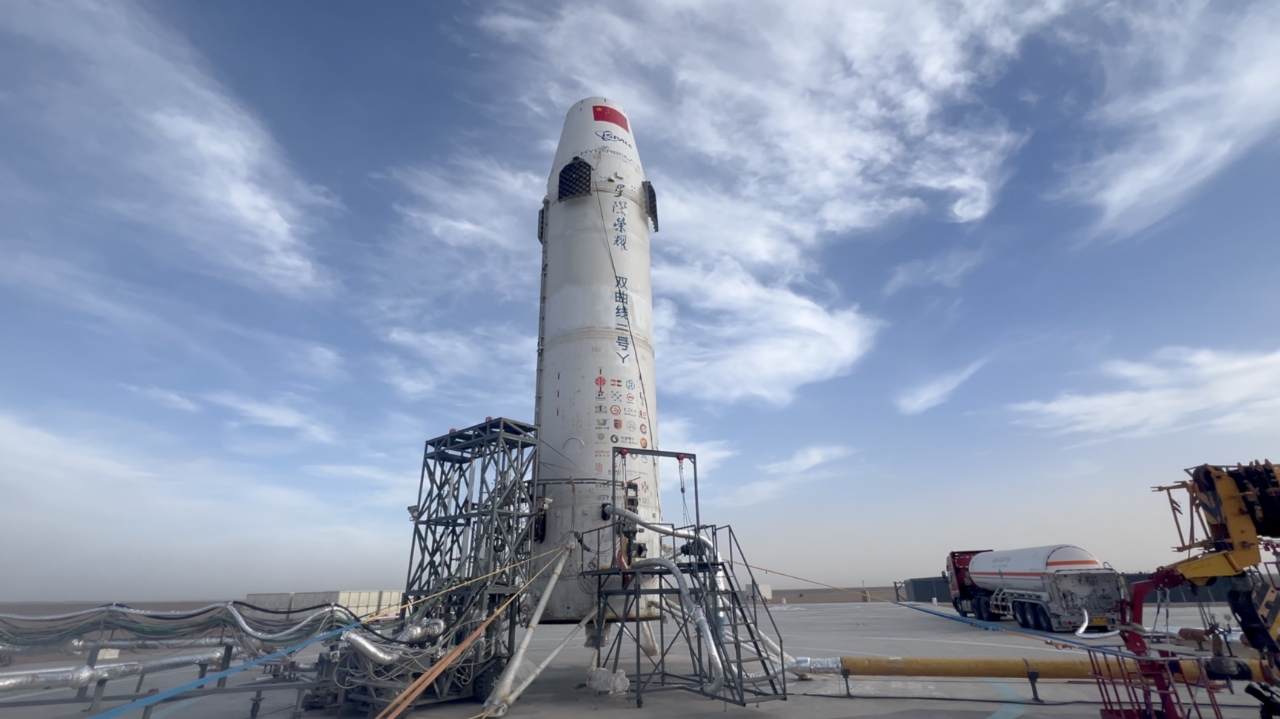
China has announced plans to launch the world’s first maglev-launch rocket by 2028, a technology that could change the speed, cost, and accessibility of space travel. Unlike traditional vertical liftoff, the system accelerates a spacecraft horizontally using magnetic levitation, allowing the vehicle to reach near-space velocity before ignition. If successful, this would mark one of the most significant breakthroughs in commercial and scientific spaceflight in decades.
How the Maglev Rocket System Works
The concept is similar to high-speed maglev trains, but applied to spacecraft. The rocket begins inside a sealed, vacuum-assisted launch tube. Electromagnetic coils accelerate the craft along a magnetic rail until it reaches hypersonic speeds. Only then do onboard engines ignite, dramatically reducing the amount of fuel needed for liftoff.
The aerospace division of the China Aerospace Science and Technology Corporation (CASC) reports that a full-scale test system designed for orbital payloads is already under development. The maglev launch track would stretch several kilometers and end with an upward curvature directing the rocket toward the upper atmosphere.
Why Maglev Launch Matters
Traditional rockets must burn tremendous quantities of fuel to escape Earth’s gravity. The maglev approach offloads that initial acceleration to ground-based electric power, which leads to three major advantages:
Reduced Cost
Because onboard fuel requirements drop dramatically, launch prices could fall by up to 70 percent, according to early projections referenced in the Chinese Academy of Sciences engineering brief.
Higher Reusability
Less structural stress and lower thermal strain mean booster stages become easier to reuse. China says the maglev system is being designed with rapid re-launch cycles similar to the ambitions of SpaceX’s Starship program.
Ultra-High Launch Frequency
Maglev tracks can cool and reset far faster than launchpads. Government-backed technology journals suggest that, in the long term, daily access to orbit could become possible.
Competition and Global Context
China is not the only country researching maglev-based or horizontal-assisted spaceflight, but it is now the closest to a full-scale launch deadline. NASA has previously studied electromagnetic launch concepts, and the U.S. Naval Research Laboratory developed demonstrators, but none have yet reached operational status. Japan and Europe have also explored variations, though not for orbital launch.
If the 2028 demonstration succeeds, China would become the first nation to prove that magnetic acceleration can replace the most expensive part of rocketry — the initial ascent through dense atmosphere.
What the 2028 Demonstration Will Attempt
Leaked specifications published through industry sources describe the following mission outline:
- A horizontal maglev acceleration track several kilometers long
- A sealed vacuum tube to reduce drag
- Acceleration to over Mach 1 before rocket ignition
- Orbital deployment of a small satellite payload
- Partial first-stage recovery
Chinese state media has stated that the long-term goal is human-rated maglev spaceflight by the 2030s, enabling point-to-point global travel in under one hour using suborbital trajectories.
Risks and Engineering Challenges
Despite the excitement, the system faces major questions:
- Magnet-to-rocket thermal transfer during acceleration
- Maintaining vacuum pressure in a multi-kilometer tube
- Structural tolerance of launch vehicles at horizontal ignition
- Acoustic shock during exit from the sealed launcher
Some Western analysts have also expressed concerns about dual-use applications, noting that maglev-assisted launch could theoretically support rapid-deployment military payloads.
Beyond Space Travel: The Real Long-Term Leap
Although the 2028 launch is expected to carry only a small satellite, researchers suggest that the bigger milestone is not the payload, but the shift to electric-powered launch infrastructure. If electricity — rather than chemical fuel — becomes the primary driver of early ascent, the environmental and economic model of spaceflight changes fundamentally.
China’s long-term roadmap hints that maglev systems may eventually link directly with reusable aerospace planes, bringing together:
- Horizontal magnetic acceleration
- Suborbital point-to-point travel
- Reusable spacecraft
- Automated launch cadence
A world where space becomes a transportation layer, rather than an extreme frontier, appears to be the intended destination.
Conclusion
China’s 2028 maglev rocket is not just another spacecraft prototype. It represents an attempt to redesign the physics and economics of launch itself. If the maiden demonstration succeeds, it could accelerate the shift from occasional launches to routine orbital access — and redefine global competition in aerospace for the next generation.