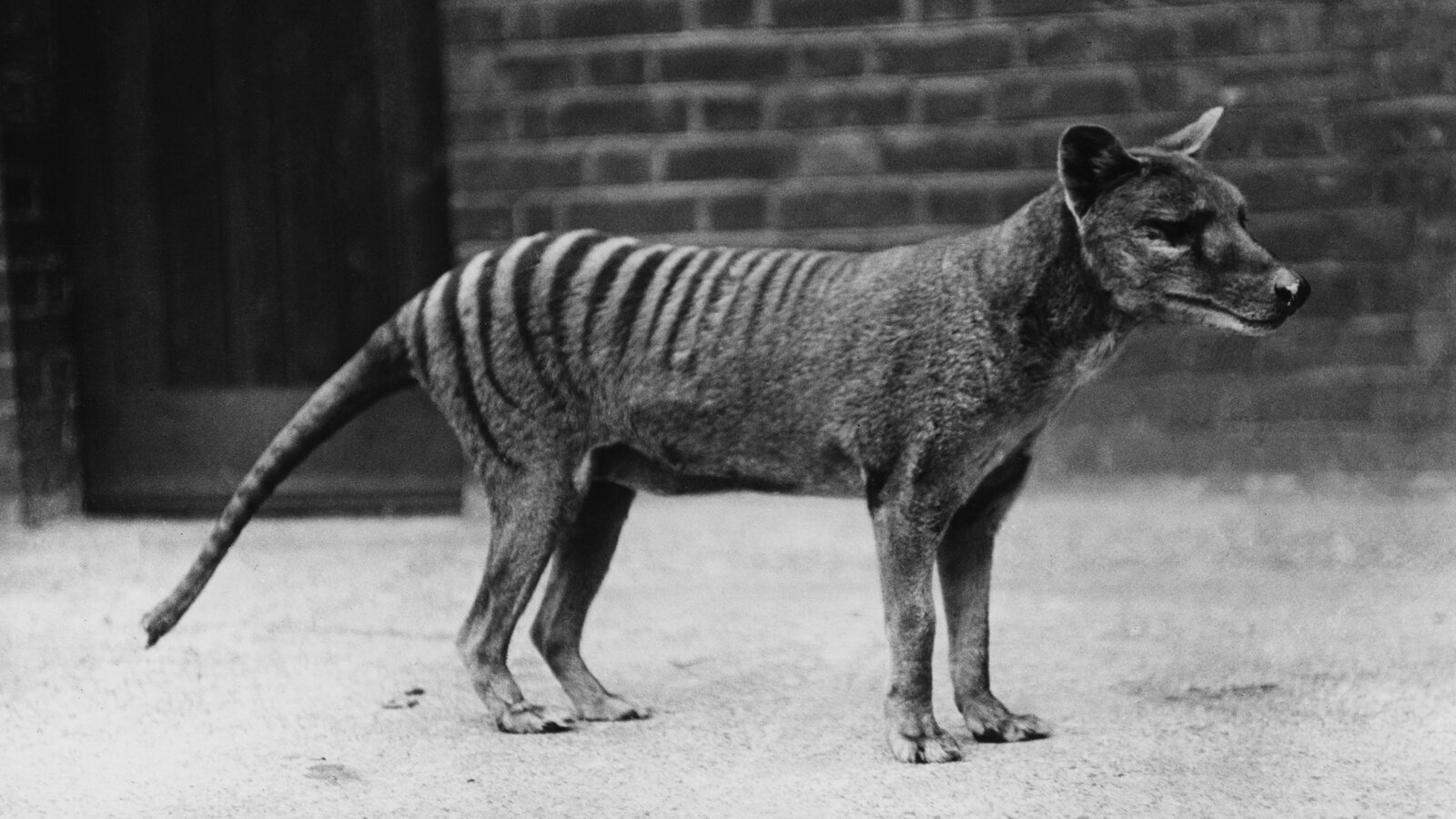
More than 90 years after the last known Tasmanian tiger — the thylacine — died in captivity, new evidence suggests that its extinction may have been declared prematurely. Genetic field traces, eyewitness records once dismissed as unreliable, and recently uncovered ecological reports are raising the question scientists once thought impossible: Did the Tasmanian tiger survive beyond 1936?
Why Scientists Are Reconsidering the Timeline
The thylacine was formally declared extinct in 1986, fifty years after the death of the final zoo specimen. But a multi-university review of wildlife archives suggests that documented sightings continued long after the extinction declaration window. Many of these reports came from remote forestry regions that biologists at the time rarely surveyed.
In the decades since, ecology tools have evolved dramatically. Modern researchers have been able to reassess old records using location reports, predator-prey imbalances, and camera-trap routes — identifying clusters of sightings that cannot be easily dismissed as misidentifications.
The shift reflects a pattern previously discussed in EOSel’s synthetic-biology coverage, where rare species once considered lost — such as select New Zealand bird populations — have later been rediscovered through revised search methods rather than luck.
The Newly Discovered Evidence
The turning point came when researchers digitizing 20th-century wildlife logs found a large set of official ranger reports referencing thylacine sightings between 1940 and 1985. Most had never been analyzed collectively.
The database revealed:
• More than 150 sightings made by trained hunters, biologists, and park staff
• Cluster patterns showing repeated reports from the same regions
• Seasonal movements that match known thylacine hunting patterns
None of this proves survival outright, but it challenges the idea that all sightings were misunderstandings.
Why Survival Would Have Been Possible
The Tasmanian tiger was not a herd animal; it was an elusive, mostly nocturnal hunter. Its historical range included dense scrubland and rugged terrain — an environment where even modern search teams struggle to locate rare predators.
Three biological factors would have supported possible survival past 1936:
- Wide territorial range that avoided human settlement
- Solitary hunting behavior that reduces detection
- Strong scent-marking communication that allows distance-based interaction between individuals
Researchers note that if the population collapsed but did not immediately reach zero, scattered individuals could have persisted undetected for decades.
The Genetic Search Effort
The most compelling evidence now comes from environmental DNA sampling — eDNA — which detects biological traces in soil and water. Several Tasmanian search teams have screened samples from remote basins and deep-forest water sources.
A 2024 analysis detected unknown carnivore DNA fragments that did not match known species in the region. While the results were inconclusive and the fragments too degraded for precise classification, they have sparked new funding for targeted biodiversity sequencing.
The technology parallels the methods examined in EOSel’s analysis of Synthetic Life for a Cooler Planet, where genetic forensics help identify elusive species and map biodiversity collapse.
Why False Hope Still Matters to Science
Some biologists warn against drawing premature conclusions — many rediscovery claims have collapsed under scrutiny. But others argue caution should not become a reason to ignore new data.
Even if the Tasmanian tiger is gone forever, the research generated by the controversy offers major benefits:
• Improved wildlife-monitoring technologies
• New extinction-risk models
• Greater understanding of how animals disappear before humans notice
The thylacine has become a symbol of preventing future extinctions, not just correcting old ones.
Could the Thylacine Still Be Alive Today?
The scientific answer remains: possible, but not proven.
The ecological consensus is evolving, and the topic is no longer dismissed as fringe speculation.
What researchers agree on:
• The extinction date may have been decades later than originally declared
• Historical findings show survival was biologically possible
• Modern search technology has not yet exhausted the evidence path
An upcoming research expedition, funded by Australian conservation groups and biome-genomics labs, will target the southwest Tasmanian wilderness, the region most consistently linked to credible sightings.
Conclusion
The “extinction” of the Tasmanian tiger may not be the closed chapter history books once suggested. Whether living thylacines remain or not, the latest research demonstrates how much remains unknown about the disappearance of wildlife — and how easy it is to declare a species gone before the full story is understood. The thylacine mystery is no longer just nostalgia; it is now an important scientific case study in how extinction is measured, recorded, and sometimes misjudged.