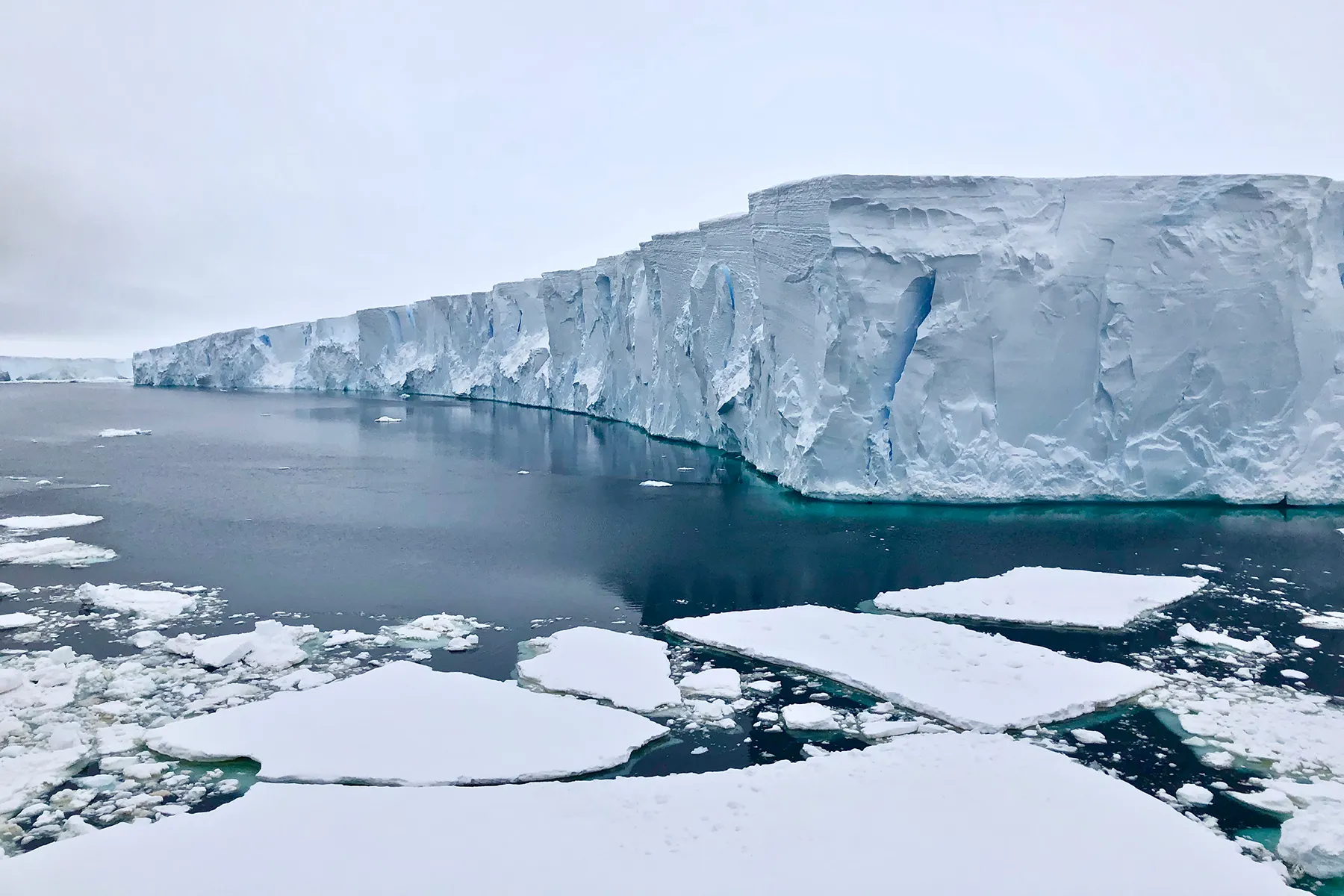
Scientists have confirmed that the Thwaites Glacier — often called the “Doomsday Glacier” because of its potential to dramatically raise global sea levels — is melting even faster than earlier projections. New research shows that warm ocean water is flowing beneath the ice sheet at greater volumes than expected, accelerating the destabilization of one of Antarctica’s most critical glaciers.
Why Thwaites Is So Important
Thwaites acts as a massive ice gatekeeper. It holds back the West Antarctic Ice Sheet, which in turn helps stabilize the wider Antarctic system. If Thwaites collapses, surrounding ice shelves could destabilize, triggering sea-level rise measured not in centimeters, but in feet.
A full collapse of Thwaites could raise global sea levels by more than two feet on its own, and up to 10 feet if the surrounding ice sheets follow. That level of rise would reshape coastlines worldwide.
Previous EOSel coverage of ocean-climate feedback loops, such as Oceans as Carbon Banks: The Race to Turn Blue Carbon into a Climate Asset, highlighted how ocean systems influence the final balance of global warming. Thwaites represents the other side of the equation — the threat of warm ocean water accelerating ice loss rather than helping stabilize climate systems.
What the New Findings Reveal
The latest observations come from autonomous underwater vehicles (AUVs) deployed through boreholes drilled into the glacier’s underside. These robots captured temperature, salinity, and pressure data from water channels beneath the ice.
The key finding: warm deep-water currents are reaching the grounding zone — the point where the glacier attaches to the ocean floor — at a higher rate than models predicted. That single detail explains much of the rapid melt acceleration.
The study indicates that water up to 3°C warmer than the freezing point of seawater is now flowing beneath the ice. A similar ocean-heat mechanism was documented in earlier cases of shelf collapse, including the Larsen B ice shelf.
Why Models Underestimated the Melt
For years, sea-level projections relied on what scientists assumed was a relatively flat grounding line beneath Thwaites. The new mapping, however, reveals a landscape full of channels, ridges, and cliffs that funnel warm water much deeper into the glacier’s interior.
This finding explains why surface temperature measurements alone failed to match real melt rates. The danger isn’t just melting on top of the glacier — it’s erosion from below.
Researchers are now updating ice-sheet models with three new dynamics:
• Under-ice erosion channels
• Turbulence patterns created by deep-water inflow
• Glacial flexing caused by buoyancy changes near the grounding line
These improved models echo the climate-model refinements discussed in earlier EOSel coverage of Digital Planet: Earth’s First Real-Time Climate Twin.
What Happens If the Glacier Cracks Further
The scientific community is watching one region of Thwaites in particular: a formation known as the Eastern Ice Shelf, which has historically acted as a stabilizing brace. Satellite imagery now shows fractures expanding across this area, triggering concern that the ice shelf could break apart within the coming decade.
If that happens, the glacier’s flow toward the sea could triple, hastening sea-level rise and impacting:
• The U.S. East and Gulf coasts
• Northern Europe
• Southeast Asia
• Low-lying island nations
This is not a distant threat. The ice shelf is already losing structural support.
Can Anything Be Done?
There is no realistic way to stop the glacier from melting, but slowing climate warming slows the pace of collapse. Most scientists agree that the decisive variable is global emissions in the next decade.
Researchers are also tracking whether melting glaciers are altering ocean circulation patterns, which could create compounding feedback loops — an area tied to broader climate questions covered recently in EOSel’s Quantum Simulations for Climate Forecasting.
Some scientists are experimenting with advanced geoengineering models, including underwater sills and ice-wall stabilizers, but none are ready for live deployment and remain highly controversial.
The Timeline Nobody Wants to Predict
Forecasts vary — not because the threat is unclear, but because the collapse of a major ice system is non-linear. Once thresholds are crossed, acceleration becomes exponential.
While exact dates are impossible to pinpoint, most researchers agree on three urgent conclusions:
- The glacier will continue to retreat much faster than earlier models predicted.
- Sea-level projections must be revised upward for the 21st century.
- Adaptation planning for coastal regions is now a necessity, not a debate.
Conclusion
Thwaites has long been called the Doomsday Glacier, but that label obscures the real issue. The danger isn’t dramatic imagery — it’s the mathematics of ocean heat and ice stability. As warm ocean water continues to erode the glacier from below, the clock on sea-level rise is speeding up. The world’s coastlines, cities, and climate systems will be shaped not only by how fast Thwaites melts — but by how fast societies respond.